Georges Bizet: The Genius of French Opera
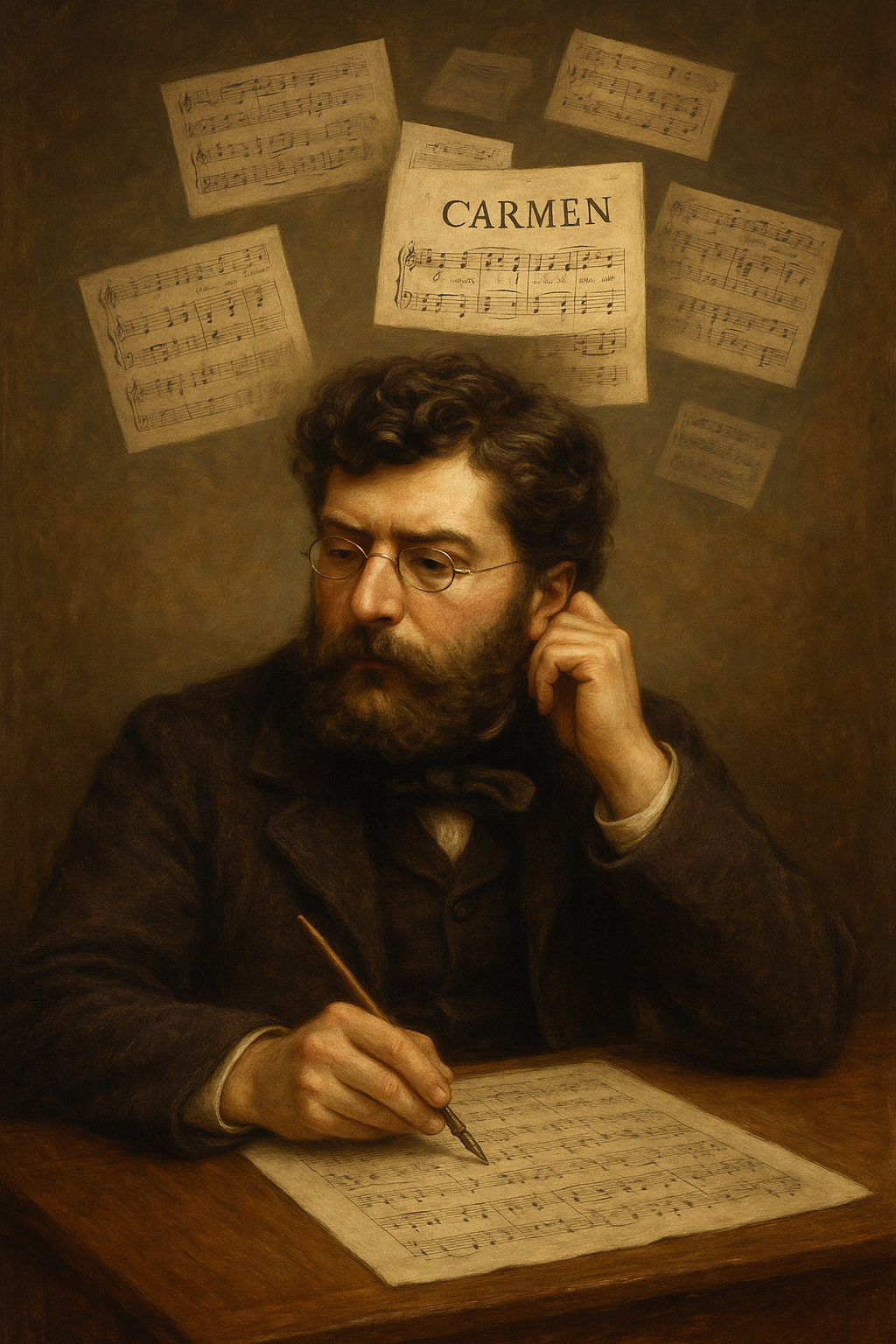
Hi, friends! If you are learning French, then you surely know that France is not only the Eiffel Tower and croissants, but also a rich musical culture. Today in our blog we will talk about the outstanding composer Georges Bizet, whose works still inspire millions. We will go through his biography, his work, his personal life, and add a few interesting facts. And at the end of the article, you will find a useful glossary with French words that appear in the context of his life and music. This will help you expand your vocabulary and better understand French culture. Let's begin!
Biography: From a Gifted Child to a Master of Opera
Georges Bizet was born on October 25, 1838, in Paris into a family of musicians. His real name was Alexandre César Léopold Bizet, but he became known as Georges. His father was a singing teacher, and his mother was a pianist. From childhood, Georges was surrounded by the world of music: he began learning to play the piano at the age of four, and at nine he was already admitted to the prestigious Paris Conservatory (Conservatoire de Paris).
At the conservatory, Bizet studied with masters such as Charles Gounod and Fromental Halévy. He quickly proved himself a child prodigy: in 1857, at the age of 19, he won the Prix de Rome — one of the most prestigious awards for young composers. This allowed him to spend three years in Italy studying art and composing music. After returning to Paris, Bizet began working on operatic works, but the road to fame was not easy. He composed music for theaters, arranged other people's works, and even gave lessons to make a living.
Unfortunately, Bizet's life was short: he died on June 3, 1875, at the age of only 36, of a heart attack. This happened shortly after the premiere of his most famous opera, "Carmen", which was not a success at first.
His Work: Operas, Symphonies, and the Eternal "Carmen"
Bizet's work is a vivid example of 19th-century Romantic music. He wrote about 30 works, including operas, symphonies, and piano pieces. His style combines French refinement with elements of Spanish and Eastern music, which makes his music emotional and memorable.
One of his early significant works was the opera "The Pearl Fishers" (Les Pêcheurs de perles), which premiered in 1863. It tells of love and jealousy against the backdrop of exotic Ceylon. Another famous opera is "La Jolie Fille de Perth" (The Fair Maid of Perth), based on the novel by Walter Scott.
But his true masterpiece was "Carmen", written in 1875 based on the novella by Prosper Mérimée. It is the story of the passionate gypsy Carmen, the toreador Escamillo, and the soldier Don José. The opera is full of brilliant arias, such as the "Habanera" and the "Toreador Song". Interestingly, at its premiere at the Opéra-Comique, "Carmen" was a flop: critics considered it too bold and "indecent" because of its themes of passion and violence. However, after Bizet's death, the opera won worldwide fame and became one of the most performed operas in the world.
Bizet also composed a symphony in C major (Symphonie en ut majeur) at the age of 17, but it was forgotten and found only in 1933. His music influenced composers such as Tchaikovsky and Puccini.
Personal Life: Love, Family, and Tragedies
Bizet's personal life was no less dramatic than his operas. In 1867, he became engaged to Geneviève Halévy, the daughter of his teacher Fromental Halévy. Geneviève came from a well-known Jewish family connected with the composer Jacques Offenbach. They married in 1869 despite the resistance of the bride's family — Bizet was not rich and had a reputation as a "bohemian" artist.
The couple had a son, Jacques, in 1872. However, the marriage was not easy: Geneviève suffered from mental disorders, and Bizet experienced financial difficulties and the stress of career failures. During the Franco-Prussian War of 1870–1871, Bizet served in the National Guard, which added even more tension. Despite everything, their union was full of love, and Geneviève outlived her husband, becoming the guardian of his legacy.
Interesting Facts About Georges Bizet
-
A prodigy pianist: Bizet was an outstanding pianist. They say that Franz Liszt, upon hearing him play, exclaimed: "I thought I was the only one who could play like that!"
-
A failed premiere: "Carmen" was the cause of Bizet's depression. He died three months after the premiere, without living to see its triumph. The opera was reworked and became a hit in Vienna in 1875.
-
Influence on pop culture: Music from "Carmen" is used in films, advertising, and even sports. For example, the "Toreador Song" is often heard at football matches.
-
The forgotten symphony: The Symphony in C major was written by Bizet as a student work and lay in the archives for almost 80 years before it was performed.
Georges Bizet is an example of how talent can outlive its creator. His music teaches us passion, love, and the beauty of French art. If you are learning French, listen to "Carmen" with French subtitles — it is a great way to practice the language!
Useful Glossary: French Words from the Article
Here is a short glossary with French words and expressions related to Bizet's life and work.
- Compositeur (composer) — a person who writes music, like Bizet.
- Opéra, m (opera) — a musical-dramatic work, for example, "Carmen".
- Symphonie, f (symphony) — an orchestral work, like the "Symphonie en ut majeur".
- Conservatoire, m (conservatory) — a music school, the one Bizet studied at.
- Prix de Rome, m (the Rome Prize) — a prestigious award for artists.
- Aria, m (aria) — a solo vocal part in an opera, for example, the "Habanera".
- Pianiste (pianist) — a person who plays the piano, like Bizet's mother.
- Théâtre, m (theater) — a place where operas are staged, like the Opéra-Comique.
- Passion, f (passion) — a strong feeling, the central theme in "Carmen".
- Biographie, f (biography) — an account of a person's life, like this article.

Comments