Baron Haussmann: The Man Who Rebuilt Paris
Hi, friends! Welcome to our blog for French learners. Today we will talk about an outstanding historical figure — Baron Georges-Eugène Haussmann. If you love the history of France, urban planning, and Paris, this article is for you. We will go through his biography and how he radically changed the appearance of the capital, add some interesting facts, and at the end — a useful glossary with French words related to the topic. This will help you not only learn something new, but also enrich your vocabulary. Let's begin!
Biography of Baron Haussmann
Georges-Eugène Haussmann was born on March 27, 1809, in Paris into a Protestant family with German roots. His grandfather was a general in Napoleon's army, which may have influenced his patriotism and ambitions. Haussmann studied law at the University of Paris and quickly built a career in the civil service. He worked as a prefect in various departments of France, proving himself an effective administrator.
In 1853, his life changed dramatically: Emperor Napoleon III appointed Haussmann prefect of the Seine department (which included Paris). It was a time when France was going through the industrial revolution, and Paris, with its narrow medieval streets, could not cope with population growth and hygiene problems. Haussmann became the emperor's right hand in a grandiose project to modernize the city. He held this post until 1870, when he was dismissed due to political changes after the Franco-Prussian War.
After his resignation, Haussmann remained active: he was elected to parliament, was involved in business, and even wrote memoirs. He died on January 11, 1891, in Paris, leaving behind a legacy that still shapes the look of the city.
How Haussmann Changed Paris
Under the leadership of Baron Haussmann, the city underwent a large-scale reconstruction that lasted 17 years and cost enormous amounts of money.
Here are the key changes:
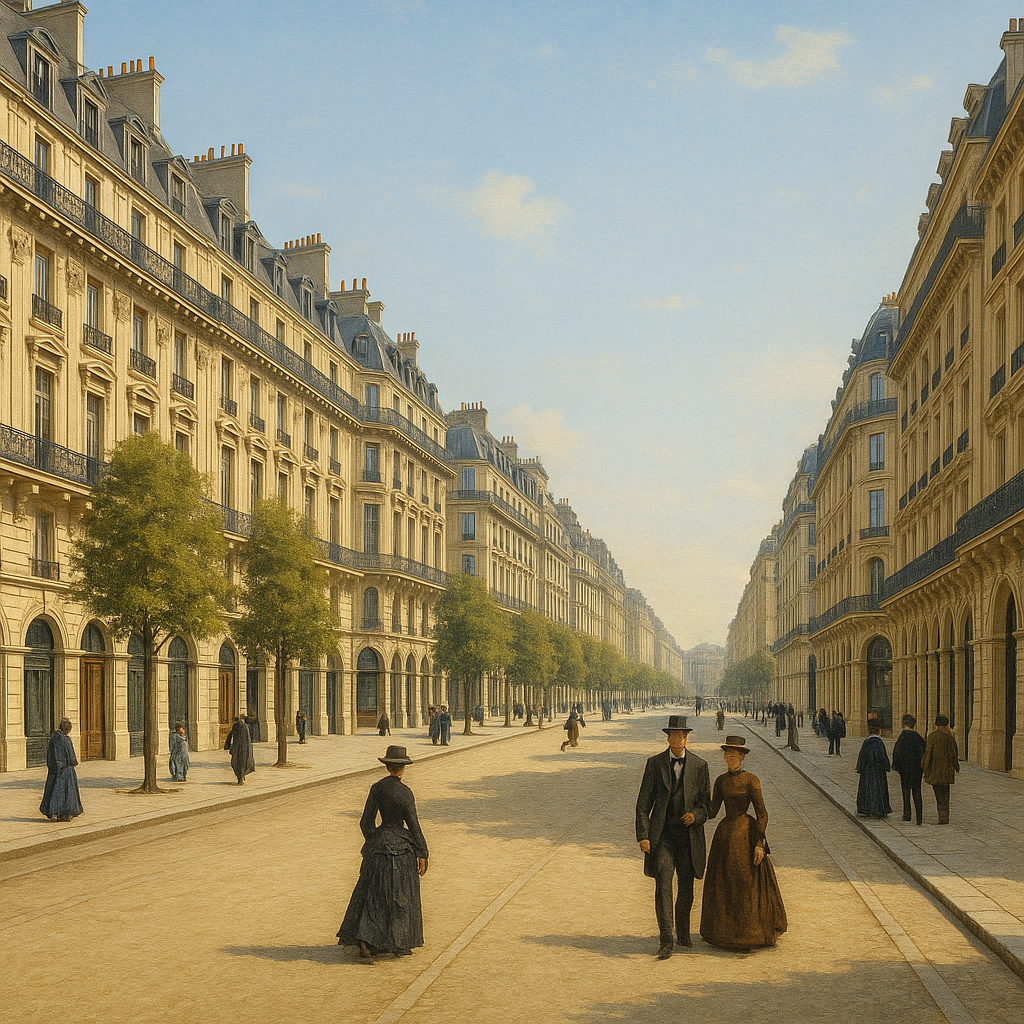
- Wide boulevards and avenues: Haussmann demolished thousands of old buildings in central Paris to lay out wide avenues like Boulevard Haussmann or Avenue de l'Opéra. This made the city more convenient for transport and trade, but also helped the authorities control crowds during uprisings — narrow streets had previously been perfect for barricades.
- Parks and green spaces: He created or expanded famous parks such as the Bois de Boulogne and the Parc des Buttes-Chaumont. These spaces became the "lungs" of the city, where Parisians could and still can relax.
- Infrastructure: Haussmann built a modern sewer system (égouts), aqueducts for clean water, gas lighting, and even the famous Opéra Garnier. Paris became cleaner, brighter, and healthier — cholera epidemics became a thing of the past.
- Architectural style: Buildings in the "Haussmann" style are elegant facades with balconies, mansard roofs, and a uniform design. They define the "classic" look of Paris today.
As a result, Paris turned from a medieval labyrinth into a modern metropolis — the "City of Light" (La Ville Lumière). However, the reconstruction was harsh: about 350,000 people were evicted, and poor neighborhoods were simply demolished. Haussmann was accused of corruption and extravagance, but his vision made Paris an icon of urban planning.
Interesting Facts About Baron Haussmann
- The title of baron: Haussmann was not born an aristocrat — he received the title of baron from Napoleon III in 1857 for his services. It was the emperor's way of rewarding loyal officials.
- Financial scandals: The reconstruction cost 2.5 billion francs (a huge sum for that time), and Haussmann was accused of real estate machinations. He allegedly speculated in land, but no evidence was found.
- Influence on other cities: "Haussmannization" inspired urban planners around the world — from New York to Buenos Aires. Even in Russia, in Saint Petersburg, there are elements of similar planning.
- Personal life: Haussmann was married to Octavie de Laharpe and had two daughters. He was known as a strict but charming man who loved theater and music.
- Legacy today: Many Parisian streets bear his name, but not everyone loves Haussmann — critics say he destroyed the "soul" of old Paris. Nevertheless, without him the Eiffel Tower and the Seine would look different!
If you are in Paris, take a walk along Boulevard Haussmann — and you will feel the spirit of that era. And for French learners: try to describe these places in français!
Useful glossary:
- Avenue(f) — avenue
- Boulevard (m) — boulevard
- Préfecture (f) — prefecture (an administrative body)
- Reconstruction (f) — reconstruction
- Urbanisme (m) — urban planning
- Égout (m) — sewer, drain
- Parc (m) — park
- Façade (f) — facade (of a building)
- Baron (m) — baron
- Empereur (m) — emperor
I hope the article was useful and inspired you to learn French! If you have questions or want more facts — write in the comments. À bientôt! (See you soon!)

Comments